1.
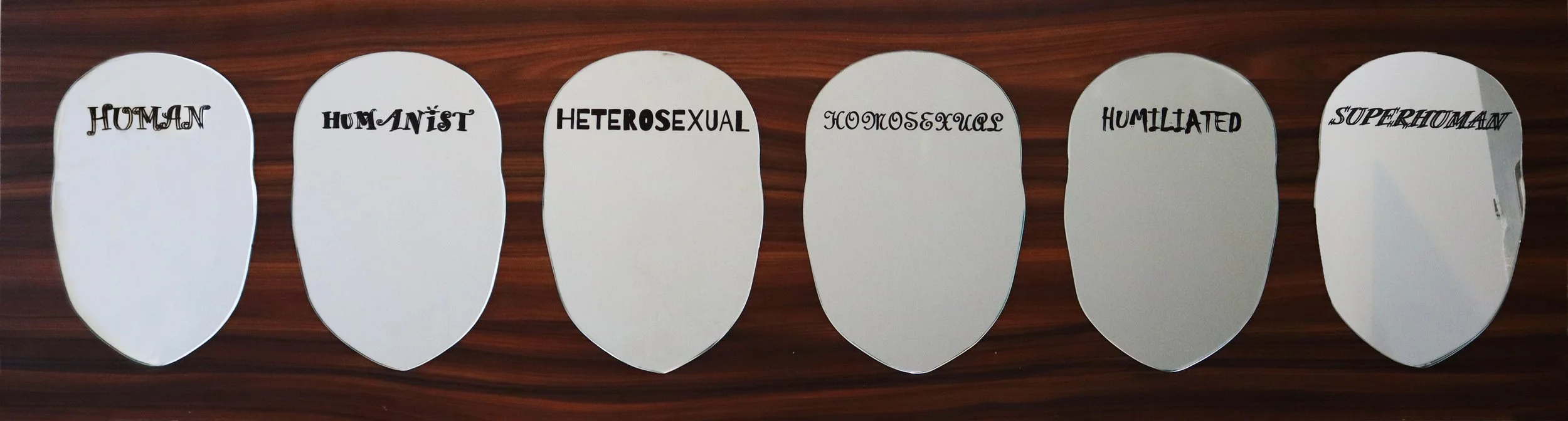
“Mirror Faces”
In Turkish culture, there exists a poignant tradition in which certain words: Human, Humanist, Homosexual, Heterosexual, Humiliated, and Superhuman are imagined or inscribed upon the forehead, as if destiny itself were written there for all to see when one meets their own reflection. These "Mirror faces," as they are called, hang on a wall in the mind’s gallery, and the act of looking into a mirror becomes a ritual of recognition and redefinition. Each label carries with it a cluster of histories, expectations, fears, and aspirations, and when a person encounters their reflected visage with one of these words hovering above, they do not merely register an image; they feel the tug of identity, ancient narratives and personal choices converging in a single moment.
For some, the word etched upon the brow affirms a long-sought belonging or a proud declaration of self-hood. For others, it can feel like an accusation or a gauntlet thrown down by society. The labels may point to social roles and relationships—heterosexual or homosexual—while others gesture toward ethical temperaments—humanist—or to emotional states—humiliated—or to mythic transcendence—superhuman. To see any of these words reflected back is to experience a reorienting shift: a reconsideration of who one has been, who one is, and who one might become.
I believe that everyone who pauses before these Mirror Faces will be touched by that shift, however subtle. The mirror does more than reproduce features; it stages an encounter between the self and the forces that name it. In that instant, identity is not fixed but negotiated; reshaped by history, language, and the intimate, often contradictory, yearnings written, imaginatively, above the brow.